



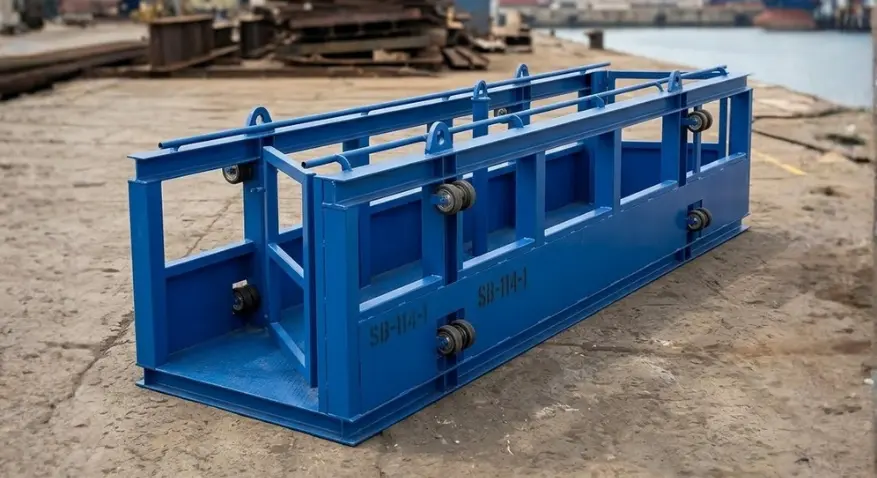

Auxiliary equipment used in shipyards is not just simple field products selected to do the job. Whether used for personnel transportation, load handling, site access or special operational needs, they must be evaluated together for safety, durability, suitability and technical verification. This is because the size of the equipment used in shipyard sites, the way it is used, the lifting method and the loads it is exposed to can often be different and more critical than standard site conditions.
Therefore, when purchasing auxiliary equipment for shipyards, it is not correct to make decisions based solely on price, delivery time or appearance. CE Certificate, static report, weld test and load transportation report Technical documents, such as the technical documentation, are of great importance for the product to be used safely in the field, to pass through corporate procurement processes and not to cause problems in audits.
Especially in shipyards, since the needs are often project-based, any equipment produced in standard sizes may not be fully suitable for every site. At this point, the right approach is not only to buy products, but also to purchase equipment that is suitable for the use scenario, documented and special production that can be designed as auxiliary equipment.
1. Why do shipyards need customized equipment instead of standard products?
Shipyard operations differ from standard construction site use due to open site conditions, different heights, heavy lifting scenarios, narrow access areas and different equipment combinations. Therefore, not all auxiliary equipment may be suitable for every shipyard operation. For example, the size, entrance structure, connection details or lifting points of the equipment to be used for personnel transportation, material handling or special site access may vary according to the project needs.
Standard products may work in some areas, but in shipyards, size, capacity and usage often require special consideration. Therefore, when selecting auxiliary equipment, it is not only “off-the-shelf”, which is really appropriate for the field solution should be preferred. This is where a customized production approach and technical documentation become important together.
Expert Note In the case of auxiliary equipment used in shipyards, it is not just about the existence of the product, but that it is actually suitable for the use scenario and technically validated.
2. What does CE Certificate Indicates in Auxiliary Equipment Selection?
The CE Certificate is an important element of confidence that the product is presented with a production approach that takes into account the relevant basic conformity requirements. Especially in corporate procurement processes, for technical teams and OHS units, the CE certificate shows that the product is handled within a certain conformity framework, not randomly.
However, the critical point here is this: CE certification alone is not the answer to all technical questions. The strength of the auxiliary equipment in the actual field, the carrier logic, the welding quality and the capacity for safe use must also be verified. Therefore, the CE certificate should be seen as a starting point and the decision process should be completed together with other technical reports.
- Institutional Trust: It shows that the product is not handled haphazardly, but with a focus on relevance.
- Ease of Purchase: It provides a significant advantage for technical teams and purchasers in the pre-assessment phase.
- Audit Advantage: It contributes to a more reliable evaluation of the product, especially in corporate and disciplined fields.
3. Why is a Static Report a Critical Security Indicator?
For heavy steel auxiliary equipment, the static report is critical for the engineering evaluation of the product's structural system logic. The equipment used in shipyards is often not only stationary; it is loaded, lifted, guided and subjected to different stresses in the field. For this reason, it is not enough that the product only “looks robust”.
The static report gives confidence in the load-bearing structure of the equipment and provides technical confirmation, especially in the purchasing decision. If the size, intended use and structural solution of the product varies according to the project, the importance of this report increases even more. Because even a small design difference in heavy field conditions such as shipyards can directly affect the safety of use.
4. Why the Source Test Should Be Asked Carefully
One of the most critical aspects of heavy steel auxiliary equipment is the quality of the joint. Just because the product looks smooth on the outside does not mean that the weld quality is sufficient. Especially in equipment that is loaded, lifted or related to personnel safety, weld quality is one of the main determinants of long life, strength and safety.
Weld testing shows that production is not just about visual aesthetics, but about technical competence and quality control. This is even more important in disciplined and heavy operation areas such as shipyards. Because the real value of the product is often revealed not under the paint, but in the carrier system and welding discipline.
5. Why is the Cargo Transportation Report Decisive in the Procurement Decision?
In order to assess the safe handling capability of auxiliary equipment, the load handling report is extremely important. Especially for equipment that involves a lifting and handling scenario, the user side naturally asks the question: “Under what conditions and within what limits can this equipment be used safely?” The load bearing report is one of the most critical technical bases for this question.
In the purchasing process, it is not enough to look only at the product photo, size or general description. Use capacity, safe limits and operational logic must also be evaluated. The load transportation report shows that the product is not only manufactured but also handled within the framework of technical responsibility.
| Document / Report | Why is it Important? |
|---|---|
| CE Certificate | It shows that the product is handled in a compliance-oriented and corporate framework. |
| Static Report | Supports the engineering assessment of structural safety. |
| Source Test | It gives significant technical confidence in the quality of manufacturing and joint safety. |
| Load Transportation Report | It helps to assess the product's capacity for safe use and operational suitability. |
6. Questions to Ask When Choosing Auxiliary Equipment for Shipyards
Asking the right questions during the purchasing or technical evaluation process significantly reduces the risk of choosing the wrong product. The following questions can be considered as a basic checklist when selecting auxiliary equipment for shipyard use:
- • For which use case is this equipment intended?
- • Is CE certificate available?
- • Is a static report available?
- • Has the source been tested?
- • Is there a load transportation report?
- • Can the size and design be adapted according to the project needs?
- • Has the suitability of the crane, site and operation structure been assessed?
- • Is the necessary technical documentation provided during the corporate delivery process?
Practical Checklist: When buying auxiliary equipment, it is necessary to question the CE certificate, static report, welding test and load-bearing report at the same time as the size, intended use and price.
7. When is custom-made auxiliary equipment the right choice?
If the site dimensions are non-standard, if the type of use requires a special solution, if the lifting or access logic cannot be fully met with standard equipment, custom production may be a much better choice. A significant part of the auxiliary equipment in shipyards is already shaped directly according to the site needs. Because every operation, every area and every load scenario has its own specific conditions.
A tailor-made approach does not only mean changing the size. It also means addressing safety of use, operational efficiency and technical suitability together. For this reason, custom-made auxiliary equipment in shipyard projects is often a more efficient, safer and more accurate solution than the standard product.
Conclusion Prefer Verified and Project Appropriate Solution, Not Undocumented
For shipyards, the selection of auxiliary equipment is not only a product purchase decision; it is also a decision of safety, corporate compliance and operational accuracy. For this reason, technical documents such as CE certificate, static report, welding test and load carrying report are integral parts of the evaluation process.
The right equipment is equipment that is suitable for the site, has a clear intended use, is technically supported and can be produced project-specific when necessary. Especially in heavy field conditions such as shipyards, it is much healthier to turn to long-term and verified solutions rather than short-term solutions.
For your auxiliary equipment needs suitable for shipyard use, you can contact us about project-specific production and technical documentation options.
