



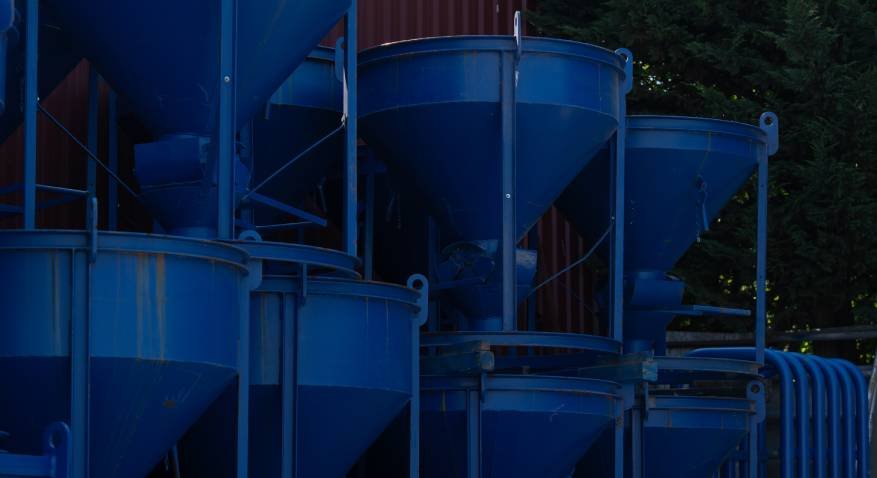

5 Critical Features to Consider When Choosing a Concrete Bucket: The Key to Productivity on the Jobsite
The safe, fast and efficient transportation and pouring of concrete on construction sites is vital to the success of the project. One of the basic equipment used in this process is concrete bucketis. Whether it is a building construction or a bridge project, the right crane concrete bucket choice of the most cost-effective and safe way to work not only improves work safety but also saves time and money.
Many different models on the market concrete discharge bucket, concrete pouring hopper or mortar transportation bucket but to choose the right one for the specific needs of your project, you need to pay attention to some critical features.
Ideal for your construction site concrete boiler or mortar discharge bucket5 important features to consider when choosing the right one:
1. Capacity and Throughput Alignment
Your choice concrete bucketIts capacity should be directly proportional to your daily concrete needs on your construction site.
- Too small a bucket: It causes you to make more trips with the crane, leading to loss of time.
- It's an oversized bucket: It can exceed the carrying capacity of your crane and pose a safety risk. It can also affect the setting time of the concrete until it reaches the casting site.
When determining the right capacity, consider the maximum safe working load (SWL) of your crane and your casting frequency. Different volumes on the market, from 250 liters to 3000 liters concrete pouring bucket varieties are available.
2. Type and Control of the Discharging Mechanism
Concrete pouring hopper or the most critical part of the bucket is the discharge mechanism, which ensures a controlled flow of concrete. Depending on the requirements of your construction site, different types of mechanisms are among the mechanisms you will use:
- Central Discharge (Middle Cover): Ideal for column, beam or mold work where more precise casting is required. The operator has more control.
- Side Discharge (Side Sluice): It can be preferred when larger areas or foundations need to be cast quickly.
- Hydraulic or Manual Control: Hydraulic systems, high capacity and heavy concrete boiler models offer the possibility to control the casting more easily and with less power. Manual systems require less maintenance.
When choosing, prioritize ease of use for the operator and casting accuracy.
3. Material Quality and Durability
Construction site conditions are harsh. Mortar discharge bucket or concrete bucket constantly struggles with heavy loads, abrasive concrete and outdoor weather conditions. Therefore, the quality of the material used is key to longevity.
- Steel Thickness: The steel thickness of the body and bottom of the buckets determines their resistance to impact and abrasion.
- Source Quality: In order to prevent the buckets from cracking under load during transportation, the welding points must be strong and in accordance with international standards.
- Painting and Coating: Industrial paint or galvanized coating for rust resistance extends the life of the bucket, especially in humid environments.
A durable crane concrete bucket will amortize the initial investment cost in a short time.
4. Safety and Transportation Features
The safe attachment and transportation of concrete buckets to cranes is the foundation of occupational safety.
- Suspension Points: The lifting lugs (suspension points) on the bucket must be robust and tested. These points must be able to safely support the full weight of the hive.
- Safety Latches/Locks: It is especially important that discharge mechanisms have safety locks or latches to prevent unwanted spills.
- Weight Labeling: Clearly indicating the empty weight of the bucket and the maximum safe working load (SWL) on the bucket prevents operator errors.
5. Ease of Maintenance and Cleanliness
Concrete is a very difficult material to clean after setting. For this reason concrete transportation bucketIts design should facilitate cleaning.
- Inner Surface Smoothness: Buckets with an inside surface as smooth as possible reduce the adhesion of concrete residues.
- Accessibility: The discharge mechanism is easily accessible for cleaning and maintenance, preventing clogging and failure of the mechanism.
- Accessories Some developed concrete discharge bucket models can be equipped with an additional concrete spacer to prevent concrete splattering or to lengthen the hopper. concrete pouring hopper accessories such as extension fittings. These accessories are easy to attach and detach, which increases productivity.
The choice of concrete bucket depends on the type of your project, the characteristics of your crane and the casting accuracy. By considering these 5 key features such as capacity, discharge mechanism, material quality, safety and ease of maintenance, you can make your concrete pouring operations on your construction site both safer and much more efficient. Remember, the right equipment guarantees a job delivered at the right time!
