



Construction Site Safety Audit: Critical Equipment for Fall, Transportation and Waste Management
Construction sites are inherently high-risk working environments. For a project manager, site supervisor or OHS (Occupational Health and Safety) specialist, an “OHS Audit” is not just a formality, but an essential part of the uninterrupted continuity of the project and most importantly employee health is a must. A small “non-compliance” detection during inspections can lead to large fines, project delays and irreparable accidents.
So what exactly does an OHS inspector look for when they come to your construction site?
Audits are usually into three main risk categories Focuses on Falls from Height, Unsafe Handling/Lifting and Site Disorganization (Waste Management).
As Bayrakcı Metal, we have prepared your critical equipment “checklist” that will help you get full marks from the audits and eliminate the risks in the field.
Category 1: Fall from Height Risks and Vertical Access Safety
The most focused issue in the inspections is the number one cause of fatal accidents in the construction sector. fall from height risk.
Critical Equipment: Caged Seaman Ladder
Risk: Standard, unguarded ladders used for climbing up and down shaft shafts, engine rooms or between floors.
What does the inspector look for? Are fixed vertical access points safe? Do they comply with regulations?
Solution: [Seaman Ladder], is not a standard staircase; it is a safety system. Latticed (pavilion) structure It protects personnel, its non-slip steps guarantee adhesion and it is one of the first equipment that you will get “approval” in inspections with its compliance with standards.
Critical Equipment: Safety Barriers and Edge Protection
Risk: Slab edges, elevator shafts and stairwells.
What does the inspector look for? Are temporary edge protection systems (guardrails) in place? Do they comply with the standards (wooden, flimsy barriers are not acceptable)?
Solution: Professional Safety Barriers and modular guardrail systems physically prevent personnel from falling into gaps and clearly demarcate the construction site.
Category 2: Unsafe Handling and Lifting Operations
The second largest group of risks occurs during vertical/horizontal transportation of heavy loads and personnel. Supervisors will never tolerate “makeshift” solutions (e.g. transporting personnel on pallets).
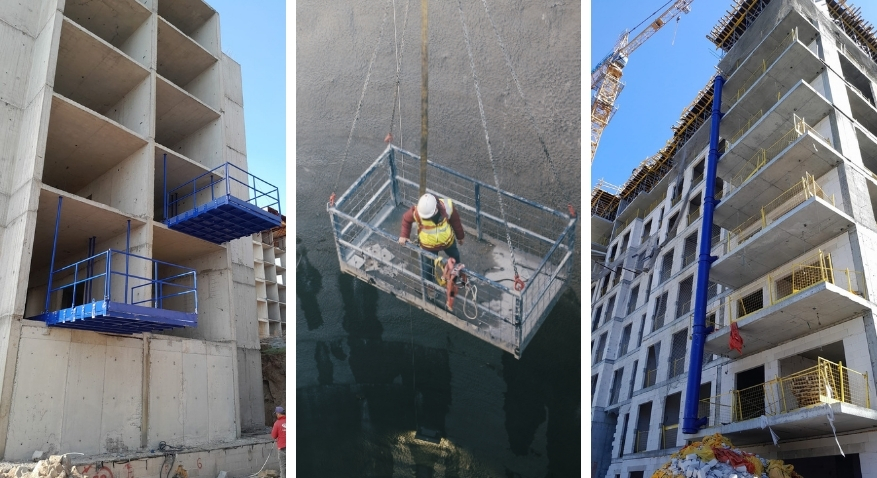
Critical Equipment: Personnel Transport Baskets
Risk: Personnel working by hanging from crane hooks, climbing on forklift pallets or working on unsafe platforms.
What does the inspector look for? Is equipment certified for working at heights *specific for people handling* used?
Solution: [Forklift People Carrying Basket] and [Mobile Crane Man Carrying Basket (Man Basket)]. These baskets are the only way to get a “compliant” report in inspections.
Critical Equipment: Load Sleeper and Material Baskets
Risk: Unbalanced handling of crane-lifted loads, slipping or breaking of the sling.
What does the inspector look for? Are the loads lifted evenly? Are the fasteners correct?
Solution: [Load Traverse (Spreader Beam)], allows especially long or unbalanced loads (beams, pipes, etc.) to be lifted safely from four points. [Construction Site Load Baskets] guarantees the safe transportation of dispersed materials such as bricks and cement.
Category 3: Waste Management and Site Disorganization
A messy construction site not only looks bad, but also poses risks such as tripping, falling and material tipping. Inspectors always examine site organization and waste management.
Critical Equipment: Rubble Disposal Chimney (Rubble Tower)
Risk: Shoveling or wheelbarrowing rubble from high floors. It is a lethal risk for people passing below, vehicles and other workers.
What does the inspector look for? Is waste discharge safe and controlled? Are environmental risks (dust, noise) minimized?
Solution: [Rubble Disposal Chimney (Rubble Tower)], is indispensable for modern construction sites. It lowers the rubble directly into the designated container in a controlled manner. Eliminates noise, dust and most importantly *accident risk*.
Category 4: Emergency and Response Plan
OHS audits do not only focus on preventing accidents; they also question what you will do *when* an accident happens.
Critical Equipment: First Aid Basket (Casualty Evacuation Basket)
Risk: When a staff member is injured on a high floor (e.g. 15th floor), trying to get them down the stairs (both delay and risk of further harm).
What does the inspector look for? Do you have an Emergency Action Plan? Do you have a procedure and equipment for casualty evacuation from heights?
Solution: [First Aid Basket], is the most critical part of your emergency plan. It is designed to safely lower the injured person and an attendant to the ground in seconds with the tower crane. Having this basket sends the message to the inspector that “we are ready for any scenario”.
Conclusion: Security is the Foundation of Your Project, Not an Expense
OHS audits are not an enemy, but a guide that allows you to see blind spots on your construction site. Investing in this critical equipment not only fulfills legal obligations, but also ensures projects are completed on time and on budget.
Bayrakci Metal all you need from the beginning to the end of your project. CE and ISO certified safety equipment as your “safety partner”. Contact our team of experts today to focus on a safe project, not inspections.
